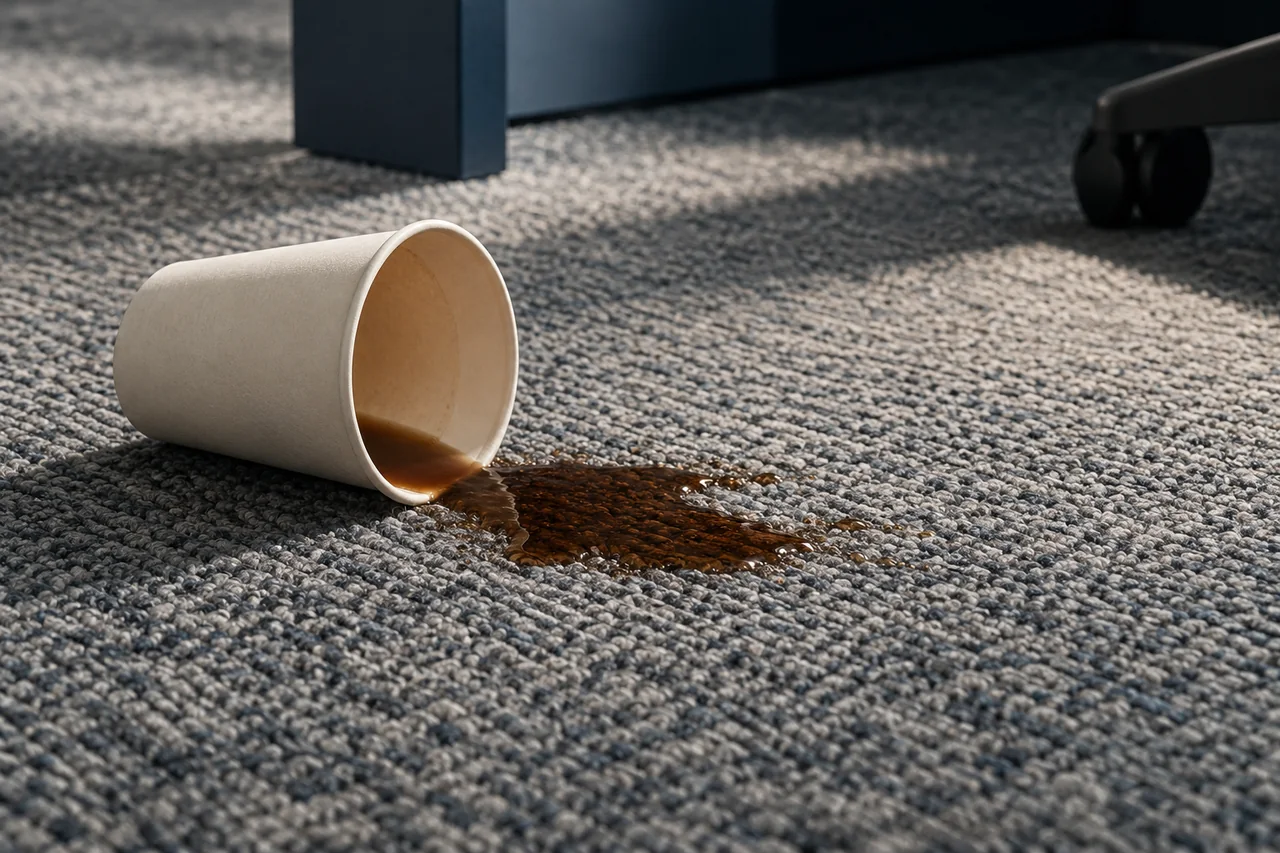
A useful report helps the next person assess the problem without guessing its history. This page is for ordinary workplace reporting. It is not an emergency response guide or advice for hazardous, biological or unidentified substances.
Describe the event rather than diagnosing the stain
Use what the reporting person actually knows. “Coffee spilled beside the meeting-room door at about 10:00” is useful when accurate. “Old coffee stain” is less useful if nobody saw the event and the cause is unknown. Preserve that distinction in the enquiry.
Give a room reference and describe the affected area. Photograph the wider location and the detail where permitted, without staff, private papers or screens. A close-up alone may show a mark while hiding that it is on a busy threshold.
What belongs in a carpet spill report?
Use the following blank record to capture the history. Unknown information can remain unknown. Do not ask someone to reconstruct a confident answer simply to fill every cell.
Swipe across the table to see all columns →
| Field | Useful entry |
|---|---|
| Location | Floor, room and position within the room |
| Time | Observed time or clearly labelled estimate |
| Substance | Known item or unknown |
| Carpet | Product or care reference if available |
| Previous action | Product, action and timing, if known |
| Current access | Relevant site arrangements and responsible contact |
Keep the names of any products used. An account of previous treatment can matter to the assessment even when it has not improved the appearance. Do not conceal an unsuccessful attempt or describe the area as untreated when it is not.
Avoid adding uncertainty through improvised treatment
The Carpet and Rug Institute’s commercial guidance advises prompt spill attention and following appropriate product directions, with pretesting. It also warns against scrubbing. Product-specific instructions and the site’s arrangements still govern the actual response.
For a known ordinary liquid spill where the carpet’s instructions allow, the Institute describes blotting with a plain white absorbent cloth or paper towel. Keep the action gentle and record what was done. This does not apply as a general response to hazardous, biological or unidentified substances, which need the site’s appropriate procedure.
Do not use this general guidance to choose chemicals for an unknown carpet or substance. Report the event and seek an assessed next step when uncertain. Repeatedly applying different products can also make the history harder to explain to the person reviewing the area.
What if the mark remains after the initial response?
Record what is visible and when it was checked. A remaining mark is not enough to establish its cause, permanence or treatment. Ask for an assessment and provide the report rather than requesting a guaranteed removal before the material has been reviewed.
Pristine does not hot-water-extract viscose, rayon or art silk. A localised spill does not remove the need to identify suitable materials and methods. An enquiry or photograph does not establish that a site visit can take place immediately.
Send a useful London office enquiry
Give Pristine the postcode, spill report, photographs and your available access times through the office carpet service. Keep immediate safety and any urgent site response with the appropriate responsible contact.
Request an assessment for suitable commercial carpet work, subject to survey and availability. The report helps define the question; it is not a promise that every mark can be removed.
Message Pristine on WhatsApp or send an enquiry. Share the London postcode and the details relevant to this problem. WhatsApp 07488 325796; info@london-carpet-cleaner.co.uk.