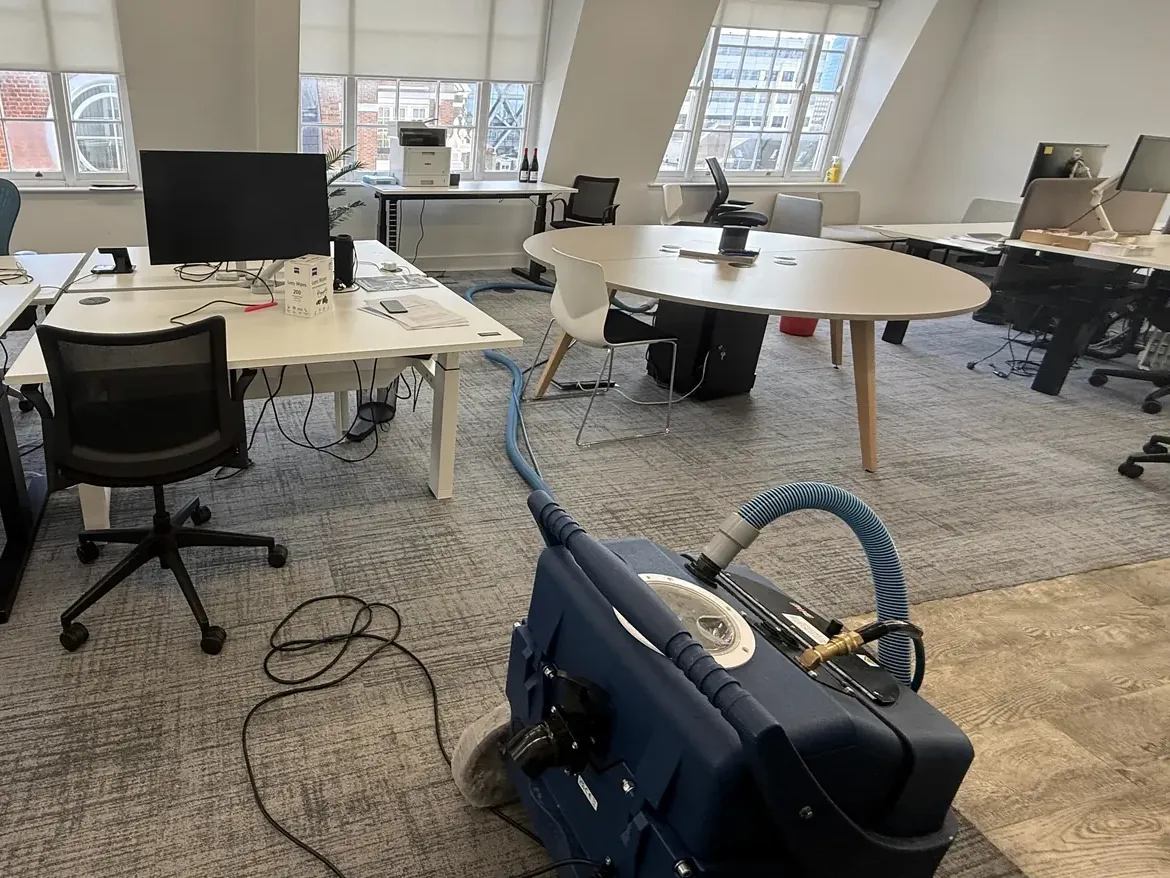
For a facilities manager in London, the problem often appears when somebody says “the cleaner deals with the carpets” and different people mean different things. One person means vacuuming as part of the regular office clean. Another expects a response to every mark. A third believes a separate periodic programme is already included. Those assumptions can produce a gap even when each supplier is following its own instruction.
This article provides a task-boundary sheet for the manager coordinating the work. It does not interpret an existing contract or change anyone’s responsibilities. Use the actual agreed documents and authorised contacts to settle the instruction for your building.
Read the current routine scope before adding another instruction
Start with the existing office-cleaning specification and any agreed variations. Look for the locations, tasks, frequency and exclusions relevant to the carpet. Ask the authorised contact to clarify wording that is too broad to guide a real decision.
A phrase such as “floor cleaning” may cover several finishes and several kinds of activity. It should not be treated as proof that every carpet method or stain treatment is included. Equally, do not assume a task is excluded simply because the office team calls it routine care. Read what has actually been agreed.
Identify the practical owner of the current instruction. If the contract is managed centrally, the local office manager may need to refer a proposed change to that team. If a managing agent controls the shared corridor while a tenant controls its own suite, separate those boundaries before adding any work.
Keep a note of unresolved wording and the person who will clarify it. The aim is to avoid two suppliers working from different assumptions, not to rewrite a contract from a blog template. Where interpretation or commercial obligations are disputed, use the appropriate authorised advice rather than asking the cleaner on site to decide.
Describe the periodic task separately
For a commercial carpet enquiry, identify the areas and intended outcome. Explain whether you want an assessment of accumulated soil, particular marks, an existing maintenance programme or another defined concern. The surveyor needs that description alongside the carpet information and access arrangements.
A periodic visit should have its own written scope, including the proposed method and relevant exclusions following assessment. Avoid asking for a “deep clean of everything” without identifying the carpeted zones and furniture arrangements. That wording makes it harder to compare the new instruction with the routine contract.
The Carpet and Rug Institute’s commercial maintenance standard distinguishes levels of care within a wider programme and points readers to manufacturer guidance. This supports treating the activities as connected decisions. It does not determine what your current contract includes or set a universal schedule for a London office.
Keep the commercial maintenance page as the resource for programme planning. The task-boundary sheet in this article is about coordinating responsibilities between the people doing that work.
Give each team the information it needs
The routine team may hold useful observations about where marks appear, how a room is used and what has already been tried. Ask for relevant factual information, including products or treatments where records are available. Do not ask anyone to guess a stain’s cause or retrospectively invent a treatment history.
The periodic contractor needs to explain what information and preparation its agreed work requires. That may include carpet specifications, access to the proposed areas and confirmation of furniture responsibilities. A site-specific request is clearer than an open-ended instruction to the office cleaner to “get everything ready”.
Keep the exchange proportionate. A carpet condition photograph should avoid unnecessary screens, paperwork or personal information. Use the building’s arrangements for permissions and distribution. The people coordinating cleaning do not automatically need every tenant or employee detail held by the office team.
Where information is unavailable, record it as unknown and identify the next step. A missing product label or absent treatment record is a question for assessment. It should not become a reason to make an unsupported claim that one team’s work caused the current condition.
Use a task-boundary sheet
The following is a blank working template for discussion with the authorised manager. It does not assign work until the relevant parties have agreed it.
Swipe across the table to see all columns →
| Activity or decision | Existing instruction to check | Proposed responsible contact | Information to exchange | Approval still needed |
|---|---|---|---|---|
| Routine carpet care | Locations and tasks in the office scope | Office-cleaning manager | Observations and agreed care instructions | Any change to the current task |
| Periodic carpet assessment | Separate enquiry or programme scope | Facilities manager and survey contact | Carpet information, areas and concerns | Survey scope and quotation |
| Report of a new mark | Building reporting procedure | Named local coordinator | Location, date and known treatment | Assessment before additional treatment |
| Preparation for a booked visit | Written furniture and access arrangement | Role agreed for that task | Readiness and unavailable areas | Scope variation if circumstances change |
| Return to routine care | Agreed completion advice | Named recipient | Relevant method and care information | Any proposed programme change |
Use the names or roles that work in your building. If the same supplier carries out both routine and periodic work, the boundaries are still useful. Different teams, prices or visit instructions may apply within one organisation.
Give the sheet a date and link it to the current scopes. An old coordination note should not override a later authorised variation. The manager needs one current view of who is expected to make the next decision.
Agree a route for new marks and unplanned requests
A request about a mark should reach the person responsible for arranging its assessment. Define that route before a problem occurs. The routine team should know what factual information to pass on and what is outside its agreed instruction.
Avoid making “try something stronger” the default response to a mark that has not been identified. Treatment suitability depends on the carpet and condition. The manager should ask for the appropriate assessment rather than allowing an informal sequence of products to become the treatment record.
If the periodic contractor is asked to add another room or another type of work, refer it through the agreed approval route. A separate visit is not a standing instruction for any work someone happens to request that day. Confirm suitability, scope, availability and price where a variation is proposed.
Likewise, do not expect the routine team to absorb extra preparation tasks without agreement. Moving furniture, clearing stored items or arranging access may involve different responsibilities. The existing furniture responsibility article provides a more detailed room-by-room discussion.
Plan the period around the visit
Before the booked work, agree which routine tasks continue and which arrangements need coordination. The periodic contractor and the authorised building contact should establish this for the actual scope. Do not apply a blanket instruction to stop or change the routine programme without checking its effect elsewhere.
After the visit, give the agreed completion information to a named person who can share the relevant details with the routine team. That could include completed areas, exclusions and site-dependent reopening advice. Do not send a generic fixed drying time to every office floor regardless of what was assessed.
The carpet-cleaning handover record article explains what to capture at the end of the specialist visit. The coordination sheet should identify who receives that record and which routine instruction, if any, needs authorised review afterwards.
A completed periodic clean does not remove the need for ongoing care. Equally, the fact that routine cleaning continues does not establish that a particular periodic method is appropriate. Keep both decisions connected to the carpet product, actual condition and agreed scopes.
Review gaps without duplicating the programme
At a review, ask whether the same issue repeatedly falls between the scopes. Perhaps nobody is sure who receives a report from reception. Perhaps a tenant’s meeting room appears in an informal list but not in either approved instruction. Resolve the boundary before assuming the answer is another visit.
Use location references when discussing observations. The carpet condition inspection log can support that record. This article’s sheet should summarise responsibility and communication, leaving the detailed condition history in the building record.
If the review leads to a proposed change, obtain the relevant approval and update the current instruction. Do not describe an agreed discussion as a contractual change before it has been accepted. Record which version applies so that the next office or facilities manager can follow it.
Where a supplier or manager changes, transfer the current boundary sheet with the relevant records. The existing changeover article covers the wider document handover. Your sheet adds a concise explanation of how the routine and periodic teams currently coordinate.
Questions London facilities managers ask
Is vacuuming included in every office-cleaning contract?
Check the actual contract and specification. This article does not decide what a particular supplier has agreed. Ask the authorised contact to clarify the relevant locations, tasks and exclusions.
Can one supplier provide routine office cleaning and periodic carpet work?
That can be discussed, but each proposed service still needs a clear scope and approval. Pristine offers routine office cleaning alongside commercial carpet care; suitability, availability and the written instruction are agreed for the actual building.
Should the routine cleaner treat every mark before a survey?
Do not add unassessed treatment outside the agreed care instructions. Record the location and known information, then follow the building’s route for an appropriate assessment. Tell the surveyor about any treatments already used.
Can the office programme override carpet material restrictions?
No. The carpet product and care instructions remain relevant. Pristine does not hot-water-extract viscose, rayon or art-silk materials. An existing timetable is not evidence that a particular method is suitable.
Clarify the carpet-care boundary in your London office
Pristine Carpet Solutions can discuss commercial carpet assessment and routine office-cleaning enquiries for London workplaces, subject to survey and availability. Share the proposed carpeted areas, the current routine scope and the contact who can confirm the instruction. We can work towards a clear written proposal without assuming that unagreed tasks are included.
Discuss your office carpet-care responsibilities, 07488 325796, or email info@london-carpet-cleaner.co.uk. Customer response hours are 09:00–16:00 Monday–Friday, London time. Booked visits are agreed separately.