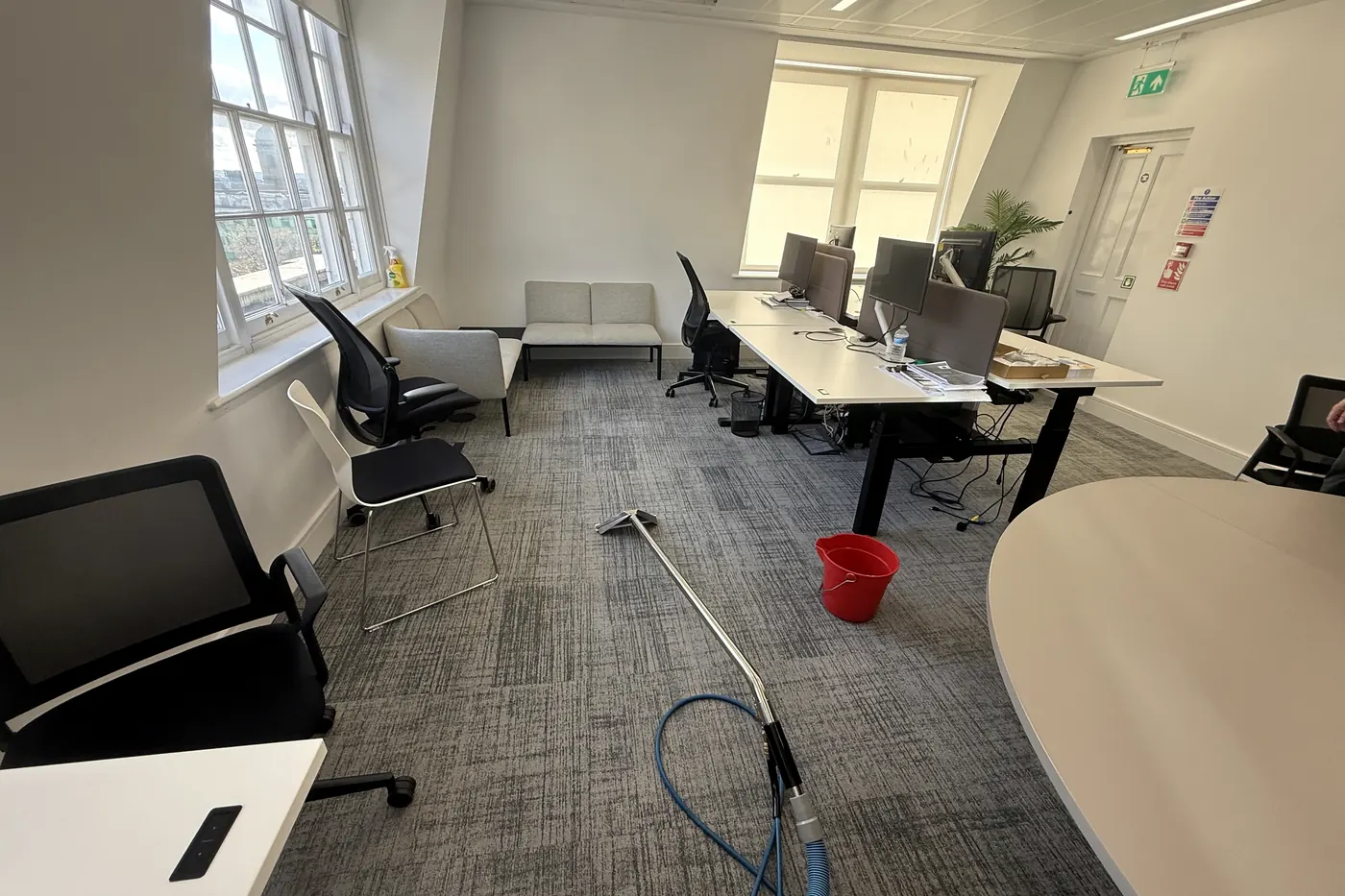
For facilities managers and building managers, the difficult part is often deciding what a trial result means. A contractor can show an area that looks different, while the manager still needs to know whether that result supports the proposed scope. A short trial brief helps both parties answer the same question instead of judging an impressive photograph without its context.
This article provides a suggested review process and a blank decision table. It is not a treatment recipe, a laboratory test or a promise that every uncertain carpet can be trialled. The surveyor must first decide whether the proposed work is appropriate. Some material restrictions remain even where a manager is willing to accept a test.
Write the question before choosing the patch
Begin with the uncertainty that is holding up the decision. Perhaps a traffic route looks markedly darker than the carpet around it. Perhaps the team is uncertain how much of the appearance is removable soil. Or perhaps previous treatment information is incomplete. These are different starting points and may need different next steps.
Write a question the proposed trial can reasonably address. “What change is observed in this identified carpet zone following the assessed treatment?” is clearer than “Can you make the floor like new?” The first invites an observation. The second mixes cleaning, wear, original colour and an undefined expectation into a promise that nobody has established.
Keep the decision boundary equally clear. You might be considering a quotation for one office floor, not approving a whole portfolio programme. State which later decision the trial will inform and who can make it. A reception contact who allows entry may not be the person authorised to approve additional work.
If the uncertainty concerns a loose tile, damaged backing, an unknown source of moisture or another defect, ask whether a flooring specialist or building team needs to assess it first. A trial clean should not become a substitute for investigating a condition outside the proposed cleaning scope.
Identify the carpet and its known history
Provide the product details and manufacturer care information available for the proposed area. Include the installation or backing information where known and the location of relevant floor features. If records are missing, say so. A confident description such as “standard office carpet” does not resolve the material question.
The existing carpet specification article explains the information request in more detail. For a trial, connect that information to the exact test location. Records for a neighbouring suite may concern a different product installed at a different time.
Tell the surveyor about previous products and treatments, including anything the local team has tried, where that is known. Record uncertainty honestly rather than filling the gap from memory. This makes the observation more useful without requiring the building manager to diagnose the carpet.
Pristine does not hot-water-extract viscose, rayon or art-silk materials. Requesting a trial does not remove that restriction. Nor does a small area establish that a proposed method is suitable for all other materials within the same building.
Choose a location that explains the intended scope
Agree the area with the surveyor rather than selecting a convenient corner solely because it is easy to photograph. Record its position on a simple plan or give it a location reference that another manager can find. Note whether it represents an entrance route, a desk area or another relevant condition.
A trial on a quiet meeting room may tell you little about the heavily used circulation route included in the wider proposal. Conversely, an isolated mark with an unusual history may be a poor basis for judging the rest of an otherwise consistent floor. Ask the contractor to explain why the proposed location is informative.
Where materially different zones exist, record which ones remain outside the trial’s conclusion. You do not need to invent a numerical confidence score. A clear statement that the result applies only to the identified product and condition is more useful than an unsupported claim of representativeness.
Agree how the area will remain identifiable during the review. Use the building’s approved arrangements and the contractor’s assessment; do not add tape, barriers or markers to the carpet without checking suitability. The point is to preserve context, not introduce another treatment or access problem.
Decide what will be observed and when
A photograph taken immediately after treatment is not a complete review. Agree when the observation should take place and what conditions need to be considered, including the assessed drying and access arrangements. Keep that timing connected to the actual method and carpet rather than a universal advertised interval.
Use the same viewpoint and comparable lighting where practical. Record any substantial difference in conditions. A photograph taken towards a bright window can tell a different visual story from one taken in the opposite direction, even without a change to the carpet. Avoid editing images to exaggerate a contrast.
Ask the reviewer to separate observations from conclusions. “The recorded traffic marking appears lighter under the agreed viewing conditions” is an observation. “The carpet will now last five more years” is a much larger claim that the trial has not measured. Keep such conclusions out of the decision record.
The Carpet and Rug Institute’s cleaning and maintenance guidance points readers towards appropriate products, methods and its commercial maintenance standard. It also discusses pretesting cleaning products. That background does not turn a site trial into a certification or replace the actual carpet manufacturer’s instructions.
Use a trial decision record
The following is a suggested blank format. It is not evidence from a Pristine customer site and it is not a universal acceptance specification. Agree the relevant fields with the contractor before the visit so neither side invents the standard after seeing the result.
Swipe across the table to see all columns →
| Review field | Record before the trial | Record at the review |
|---|---|---|
| Question | What uncertainty is being assessed? | What has been learned, and what remains unknown? |
| Area reference | Product and exact location | Any difference from the intended area |
| Condition | Visible observations and known history | Observed change and remaining limitations |
| Proposed treatment | Contractor’s assessed scope | What was actually carried out |
| Viewing conditions | Intended review arrangements | Timing, lighting and relevant changes |
| Next decision | Approver and proposed wider scope | Proceed, revise, investigate or defer |
Keep the record proportionate. A brief table with the right references can be more useful than a long report full of generic claims. Attach the relevant photographs or agreed documents through your building’s normal record system, with permission and appropriate privacy controls.
Do not copy a contractor’s marketing image into the record as if it shows your trial. If you use an illustrative example to explain the process internally, label it clearly. The decision should refer to the actual area inspected and the work observed.
Interpret a mixed result without forcing a yes or no
A trial may clarify one question while leaving another open. It could show a visible improvement in general soiling while leaving an isolated mark unresolved. It could also demonstrate that the original expectation was unrealistic. Neither outcome should be rewritten as a complete success simply because wider work was hoped for.
Consider a hypothetical London office with a dark circulation route and several separately damaged tiles. The trial might help the manager judge the appearance of the circulation carpet. It would not demonstrate that the damaged tiles can be repaired by cleaning. The record should preserve those two decisions separately.
Ask the surveyor to identify limitations in plain language. If further assessment is needed, record the next question and responsible contact. If the proposed scope changes, request the revised written proposal before approval. Avoid treating a discussion beside the trial area as automatic authority to proceed through every room.
The office carpet tile guide separates cleaning from replacement and flooring assessment. Use it where the remaining issue concerns damaged tiles. Do not assume Pristine supplies or installs replacement flooring because a trial identifies that cleaning cannot resolve a defect.
Connect the result to the quotation
Once the review is complete, check that the proposed wider scope reflects what was learned. The quote should identify the relevant areas, assessed method and limitations. A trial on one product should not silently expand into a promise for another carpet elsewhere in the building.
If the manager chooses to proceed, preserve the trial record alongside the approved scope. If the manager defers, retain the reasons and open questions. This helps a future reviewer understand the decision without interpreting silence as acceptance or assuming a trial created a booking.
Commercial arrangements for a trial and any later work should be confirmed directly in writing. Do not assume a trial is free, included, refundable or a credit against a later visit unless that has been agreed. The free site-survey offer is separate from any specifically proposed trial work.
For a later completed visit, use the handover record article to document the actual work. The trial record supports the earlier decision; it does not replace completion evidence or the agreed reopening checks.
Questions facilities managers ask
Does a successful trial guarantee stain removal across the building?
No. Its meaning depends on the identified carpet, condition, treatment and review. Record which areas it informs and which remain unassessed. Permanent damage and differences between products cannot be resolved by extending a photograph’s conclusion.
Should the building manager choose the cleaning product for the trial?
Provide the available flooring information and ask the contractor to assess the proposed treatment. This article does not prescribe products, concentrations or machinery settings. A short access window or a preferred appearance does not establish suitability.
What if the team cannot agree on the result?
Record the different observations and the unresolved question. Ask what further information or assessment would help. Do not retrospectively change the agreed review criteria or authorise wider work merely to close the discussion.
Discuss an assessed trial for your London carpet
Pristine Carpet Solutions assesses commercial carpet work for London offices and agreed managed communal areas, subject to survey and availability. Share the exact carpeted area, available product information and the question you need the survey to resolve. Any proposed trial and wider work need their own agreed scope.
Discuss a commercial carpet assessment, 07488 325796, or email info@london-carpet-cleaner.co.uk. Customer response hours are 09:00–16:00 Monday–Friday, London time. Survey and cleaning visits are agreed separately.