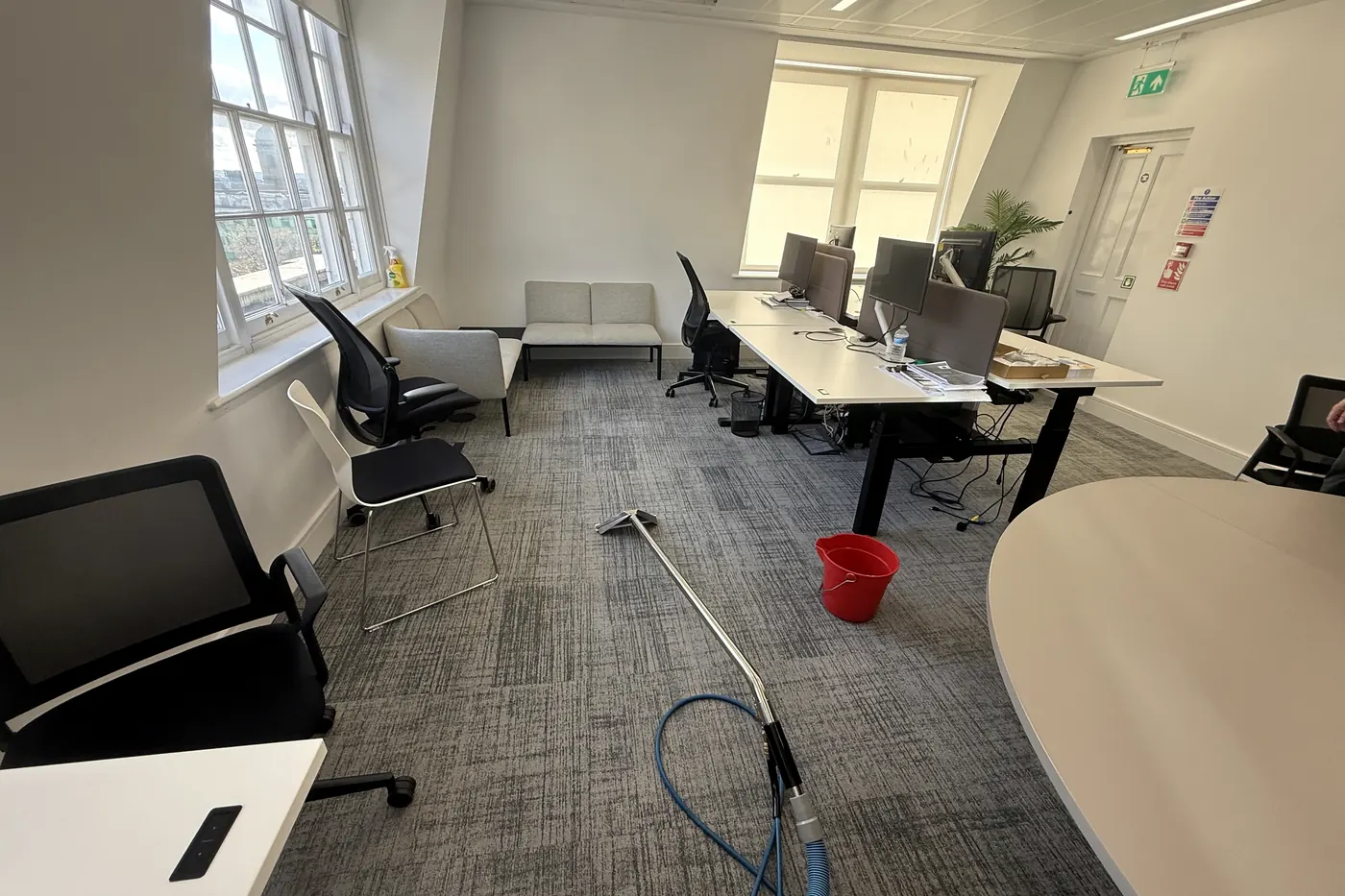
For facilities managers in London, the difficulty is often a moving programme rather than a lack of available dates. A suite appears finished, then another delivery arrives. A contractor removes protection to inspect a finish while another team is still working nearby. Carpet cleaning booked against an optimistic completion date can become an avoidable repeat visit if nobody owns the decision that the area is ready.
This guide focuses on that sequence and the boundary between refurbishment activity and a commercial carpet-cleaning instruction. It is not a construction management plan, an installation approval or a promise that cleaning will remove building products, damage or contamination.
Define the intended carpet outcome
Start by identifying whether the carpet is existing, newly installed or a mixture. Record the purpose of the enquiry: assessing retained carpet after works, preparing an occupied floor for return to use, or reviewing marks in a completed meeting suite. Those situations should not automatically receive the same scope.
New carpet may need the installer or manufacturer to address a particular concern. Existing carpet may have pre-existing wear that cleaning will not reverse. A floor with replacement tiles may have visible differences unrelated to removable soil. Make the uncertainty part of the survey brief rather than promising a uniform result before assessment.
Photograph the relevant areas with context and permission. Where possible, preserve dated condition information from before the works. Its purpose is to support an accurate discussion, not to assign blame to a trade from a single image.
If the enquiry includes paint, adhesive, plaster or another unidentified substance, describe it accurately and ask for assessment. Do not ask an office cleaner to improvise with a solvent or abrasive treatment. The material, product and contamination need understanding before somebody decides what work is suitable.
Map the routes that could soil the carpet again
A carpeted office can be complete while its delivery route remains busy. Mark the routes for remaining furniture, IT equipment, partition adjustments and contractor access. Include shared lift lobbies and corridors if they are part of the proposed carpet scope.
Ask what still needs to pass through each zone. A room that has no remaining work inside it may still be a passage to another room. A clean corridor may become the route for moving stored material out of the suite. The relevant question is therefore broader than whether the decorating has finished.
Distinguish the building’s common areas from the tenant’s refurbishment area. Agreement to clean a suite does not automatically include its shared access corridor or another occupier’s entrance. Where several parties control the route, ask them to confirm the work boundaries before the survey. Use the existing commercial survey checklist to assemble the proposed areas and current contacts.
Consider the practical order in which carpeted zones become available. A phased instruction may be suitable, but only if the boundary and continuing traffic can be managed. It should be assessed rather than assumed to work simply because rooms have separate doors.
Assign ownership of protection and its removal
Record who chooses, installs, maintains and removes temporary floor protection. The refurbishment team and the responsible building contact need to agree those arrangements with reference to the carpet product and relevant instructions. Do not assume the carpet-cleaning contractor is taking responsibility for protection supplied by another party.
Ask for any information about products placed against the carpet, especially where an adhesive-backed material has been used. The surveyor needs to know what was applied, where and for how long, where that information is available. An unidentified residue is a question to investigate, not a standard stain-removal instruction.
Protection can also hide the carpet’s condition from an early survey. Mark protected areas as not fully inspected and agree when they can be assessed. A quotation based on visible areas should say where further inspection is needed after protection is removed.
Keep the removal sequence explicit. If protection comes up before the final deliveries, the exposed carpet may receive further traffic. If it remains down until the cleaning team arrives, the condition and readiness assessment may need more time. Resolve that dependency with the project coordinator before confirming the visit scope.
Use a readiness check tied to each zone
A readiness check turns “we should be finished” into a short set of facts. It does not certify construction work or replace the project’s own completion process. It establishes whether the proposed carpet-cleaning instruction can proceed on the conditions discussed.
Swipe across the table to see all columns →
| Readiness question | Confirmation required | If unresolved |
|---|---|---|
| What work or deliveries remain? | Current programme from the project coordinator | Reconsider the visit sequence |
| Can the carpet be inspected? | Protection and stored-item arrangements confirmed | Record survey limitations |
| Is any substance unidentified? | Product information or specialist assessment route | Exclude unassessed treatment |
| Are the approved areas accessible? | Building and occupier contacts confirm access | Revise the proposed scope |
| Is carpet information available? | Product and care instructions supplied where held | Keep method approval pending |
| Who releases the zone for cleaning? | Named authorised contact | Do not assume readiness |
Add the zone reference and date to each check. A readiness decision for one suite should not be copied to a floor where work is still in progress.
Use the check before committing to the final sequence and again at the agreed coordination point. The interval depends on the actual programme. It is better to agree when confirmation will happen than to invent a universal number of days that every London refurbishment should follow.
Separate a carpet survey from construction completion
A cleaning survey assesses the proposed carpet work. It does not certify that the refurbishment is complete, that a new installation has been accepted or that all construction obligations have been discharged. Keep the purpose of the visit clear in the invitation and written record.
For construction projects, the Health and Safety Executive describes separate responsibilities for commercial clients. Refer to the project’s responsible people and the HSE commercial-client guidance where relevant. This article does not determine whether particular legal duties apply to your project or whether they have been met.
Operationally, ask the project coordinator to explain how the cleaning team will be received and what current site arrangements apply. The contractor then needs the information relevant to its agreed work. A completed carpet-cleaning visit should not be used as a substitute for any separate project inspection or approval.
If conditions differ materially from the survey, pause the scope decision and refer it to the authorised coordinator. Additional contamination, inaccessible areas or another trade working through the space can change the proposed task. Document the issue and agree the next step rather than quietly extending the original instruction.
Keep method selection dependent on the carpet
A refurbishment deadline does not establish whether a particular carpet can be wet cleaned. Request the exact product and care information available, including relevant backing or installation details. The existing carpet specification article explains what to ask for when that information is incomplete.
Pristine does not hot-water-extract viscose, rayon or art-silk materials. Unknown fibres or installation conditions require assessment; a tight handover date does not remove that requirement. Do not select a method solely because somebody has attached a generic drying period to it.
If an assessment or representative test is proposed, agree what it is intended to establish and which areas it represents. A result from one material or one type of marking should not be presented as proof that a different area will respond identically.
Discuss practical reopening with the site contact after the proposed method and conditions are understood. Drying depends on the material, method, environment and other site factors. The commercial carpet drying guide provides the wider planning context; the refurbishment programme should carry the actual agreed decision points.
Protect the result through the remaining programme
Once a zone has been cleaned, confirm who controls subsequent access and what work remains. A completed visit can be followed by more deliveries or furniture movement. If that traffic is unavoidable, the coordinator needs to decide how the sequence and any further carpet assessment will be managed.
Record later marks with the time, location and surrounding activity, without jumping to a cause. A new mark after the cleaning visit may have several explanations. Accurate notes help the relevant parties discuss it; they do not automatically establish liability or prove a cleaning failure.
Keep furniture placement consistent with the agreed scope. If items were stored in another room during cleaning, moving them back may expose additional carpet or change access routes. Agree who moves what and when, using the existing furniture responsibility article.
Where a return visit becomes necessary, request a distinct written assessment and scope. Avoid an open-ended instruction to “come back until the floor is perfect”. Cleaning has limits, and wear, damage or installation differences may require another specialist or a decision about the material itself.
Questions London facilities managers ask
Should carpet cleaning always be the final activity?
It should be coordinated with the activities that can soil the proposed areas again. Some buildings need a phased arrangement; others need to wait for particular work or deliveries. The survey and project coordinator should establish the suitable sequence.
Can a quotation be prepared before protection is removed?
A survey may support a provisional scope, with limitations clearly recorded. Areas that cannot be inspected may need reassessment before the method, price or result expectation can be confirmed.
Does commercial carpet cleaning include removal of building waste?
Do not assume it does. State the actual condition and requested work. Waste removal, hazardous material, specialist contamination and other project tasks need their own suitable arrangements; they are not automatically included in a carpet-cleaning quotation.
Will cleaning restore retained carpet to a new appearance?
That cannot be promised. Wear, fading, damage, existing treatment and the type of marking can affect the outcome. Assessment should distinguish removable soil from issues outside the cleaning scope.
Plan the carpet stage of your London office refurbishment
Pristine Carpet Solutions can assess commercial carpet cleaning for London offices and managed buildings, subject to survey and availability. Share the location, the retained or new carpet information, the proposed zones and the remaining work programme. We can then discuss an appropriate survey and written carpet-cleaning scope.
Discuss carpet cleaning around your office refurbishment, 07488 325796, or email info@london-carpet-cleaner.co.uk. Customer response hours are 09:00–16:00 Monday–Friday, London time. Visits and project coordination are agreed separately.